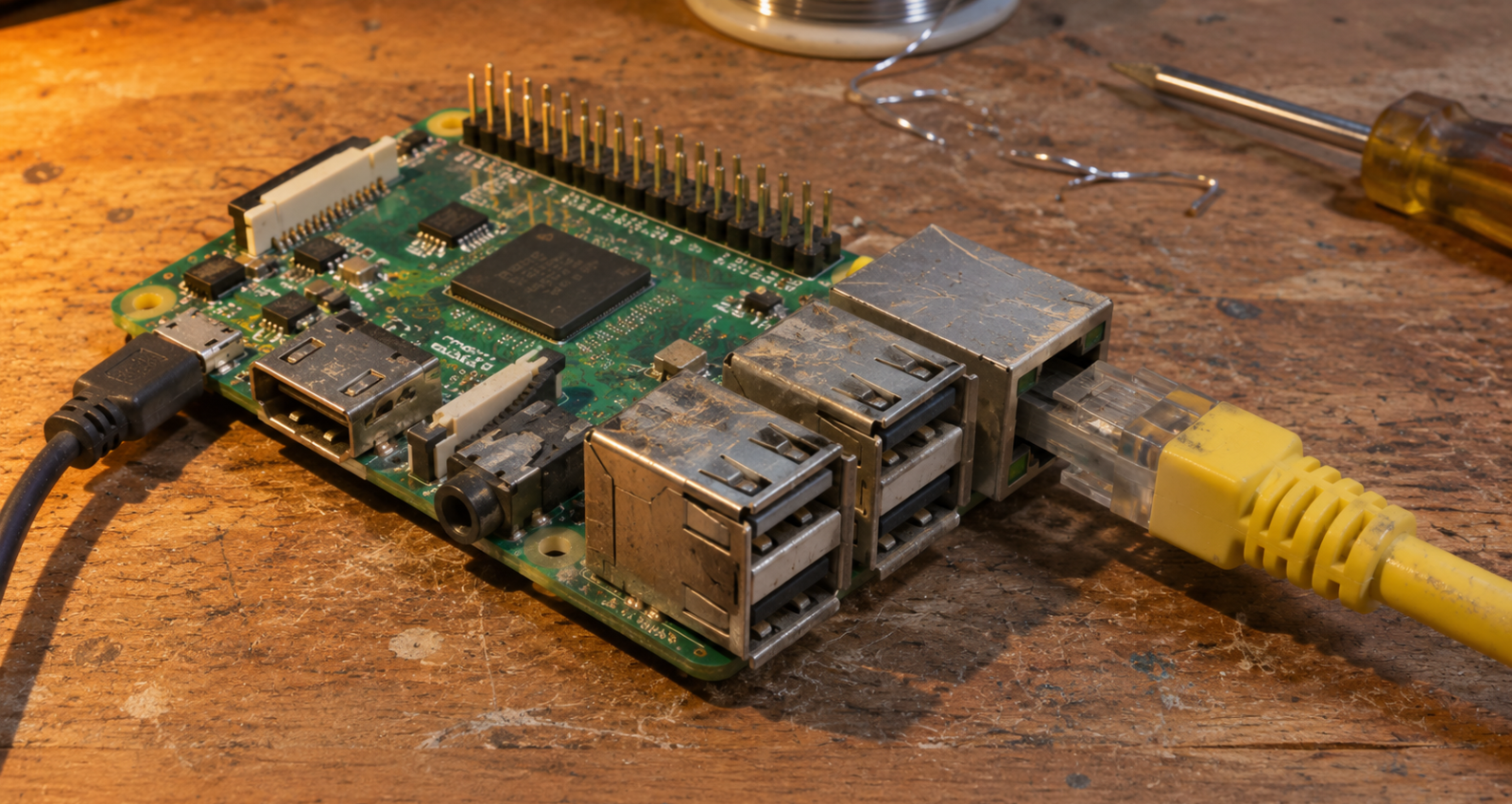
In April 2026 Raspberry Pi said it did not expect to raise prices on its classic products, and it named the Pi 3, 3B+ and 3A+ among them. The three boards differ in clock speed, memory, networking, ports and how long each one is guaranteed to stay in production.
How the Pi 3B, 3B+ and 3A+ differ
The original Pi 3 Model B runs a quad-core Broadcom BCM2837 at 1.2GHz with 1GB of RAM, 100 Base Ethernet and 2.4GHz wireless with Bluetooth Low Energy from a BCM43438 chip. It launched at $35 and is guaranteed in production until at least January 2028. The 3B+ moves to Broadcom's BCM2837B0 at 1.4GHz and keeps 1GB of RAM. It adds dual-band 2.4GHz and 5GHz 802.11ac Wi-Fi, Bluetooth 4.2 and gigabit Ethernet that runs over USB 2.0, with a maximum throughput of 300 Mbps. It has four USB 2.0 ports, also launched at $35, needs a separate HAT for Power over Ethernet, and is guaranteed until at least January 2030. In Raspberry Pi's launch measurements the 3B+ managed about three times the measured wired throughput of the 3B, so even with the USB 2.0 cap it is well ahead of the older board on a cable. The 3A+ uses the B+'s 1.4GHz chip and keeps its dual-band Wi-Fi and Bluetooth 4.2. It launched at $25 with one USB 2.0 port, no Ethernet and half the B+'s memory at 512MB, and it shares the B+'s guarantee to at least January 2030. For a build that will need a like-for-like replacement later, the two years between the 3B's guarantee and the date the other two share is what separates them.
How much more power the 3B+ draws
Raspberry Pi warned at the 3B+ launch that the board "does consume substantially more power than its predecessor". Third-party measurements published by Pi Dramble, taken with nothing plugged into USB unless otherwise noted, show the 3B+ drawing 350 mA (1.9 W) at idle against 260 mA (1.4 W) for the 3B, and 980 mA (5.1 W) against 730 mA (3.7 W) with all four cores loaded. Those measurements cover the 3B and 3B+, not the 3A+. A board that spends most of the day near idle, as a DNS filter does, only pays the smaller gap. The 3B+ is specified for a 5V/2.5A supply. Above 70°C it drops from 1.4GHz to 1.2GHz and lowers its core voltage, which delays the 80°C thermal throttle.
What a Pi 3 costs new and used
In the April 2026 post that announced more memory-driven price increases, Raspberry Pi gave its reason for leaving the classic boards out: "These products use older LPDDR2 DRAM, of which we currently hold substantial inventory." The Register reported the same exemption, with the Pi Zero, Zero 2 and Pi 1 spared alongside the Pi 3, 3B+ and 3A+. Used prices spread widely. Asking prices for a bare 3B+ on eBay run from about $20 to $50, often undated. One auction in 2025 closed at about US $31.46, and a UK listing in January 2026 asked £25.00. MakeUseOf puts a 3B+ usually in the $40 to $50 range. Measured against the $35 launch price, a used 3B+ near the bottom of those listings is the cheaper route, while one at $35 or more costs as much as a new board did at launch.
Whether a Pi 3 can run Pi-hole, Home Assistant or RetroPie
Pi-hole asks for at least 512MB of RAM and 2GB of free storage, with 4GB recommended, so every Pi 3 meets its minimum, including the 512MB 3A+. Home Assistant suggests the Pi 5 and Pi 4 for its Raspberry Pi installation, asks for a model with at least 2GB of RAM and a 32GB card, and does not mention the Pi 3. No Pi 3 has more than 1GB. The project also ended its 32-bit armv7 builds from release 2025.12, keeping only 64-bit builds, and noted at the time that Pi 3 and Pi 4 boards often run a 32-bit system even though their chips can run 64-bit. Home Assistant OS 17.0 then removed the 32-bit Pi 3 image. The project says Pi 3 and Pi 4 hardware running a 32-bit system can upgrade and migrate to a supported 64-bit version of Home Assistant OS, which means installing a 64-bit operating system and restoring Home Assistant on it. For a new Home Assistant install, the board to buy has at least 2GB.
RetroPie forum users report that PS1 emulation runs well across the Pi 3 line and that N64 on a 3B+ is hit and miss. The project's speed guide ranks the Pi 4 above the Pi 3 and advises the performance governor and overclocking for more speed.
Which Pi 3 to keep, buy or skip
A Pi 3 that is already sitting in a drawer still handles Pi-hole on any of the three models, and RetroPie forum users report PS1 emulation running well across the line, so there is no reason to replace one for those jobs. For buying one to do them, the 3B+ is the board. Buy a used one towards the $20 end of the listings rather than at its old launch price. The 3A+ fits a fixed job that only needs Wi-Fi and one USB port, and its 512MB still clears Pi-hole's minimum, but it has no Ethernet and a single USB port. For Home Assistant, every Pi 3 falls short of the 2GB the project asks for, so the step is to a Pi 4 or Pi 5 with at least 2GB, the two boards the install guide suggests.

New Raspberry Pi boards and releases are the news Eirik Haugland covers. He keeps the pieces short and dry.
3 articles →